There’s no shortage of productivity systems out there: From simple To-Do-lists to complex frameworks. As a Producer, I’ve tried quite a few over time but I often found that something was missing: Either I had visibility without commitment, structure without flexibility or complexity missing practicality.
As a founder, my days are a mix of strategic thinking, operational work and unexpected tasks. I needed a system that could handle all three. Something lightweight and flexible but still strong enough to enforce real priorities.
What I ended up with is a simple but effective hybrid: A combination of a Kanban board and a weekly calendar.
How my system works
At its core the setup is intentionally minimal. It consists of a few simple elements:
1. Backlog
This is where everything goes: Ideas, tasks, topics, appointments, deadlines. No pressure, no prioritization. Just a place to capture things outside my head.
2. Weekdays instead of status columns
Instead of classic Kanban columns like “To Do,” “In Progress,” or “Review,” I use weekdays (Monday through Friday). Every task I actually plan to work on gets assigned to a specific day.
3. Done
Completed tasks move into a “Done” column, which is cleaned up at the end of every week. It keeps things transparent and creates a clear sense of progress.
4. “Creative ripening area”
One section of the board is reserved for something entirely different: Big questions, difficult decisions, or creative ideas that need time to develop.
Usually, there is only one topic in this area at a time. It might be a strategic direction for the company, a design problem, a long-term business decision or simply an idea I’m not ready to act on yet. The purpose of this space is not execution – it’s reflection.
I’ve noticed that some of the best decisions don’t happen during focused work sessions or meetings. They evolve slowly in the background. Having a dedicated place for these questions helps me revisit them regularly without forcing immediate answers. Some ideas simply need time to mature.
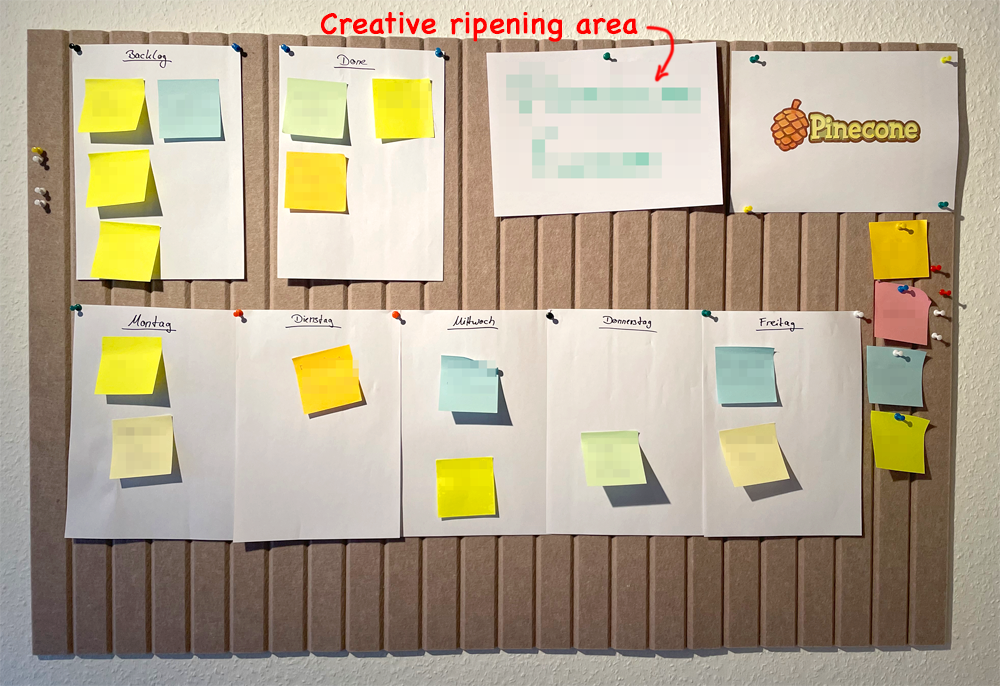
Photo of my „Kanban-Calendar“
Color-coding the different areas of work
Another part of the system is color-coding. Each Post-It note has a specific color, representing one of the four major categories of work in my day-to-day life as a founder in the games industry.
- One color for project-related work
Development tasks, production topics, design decisions and everything directly connected to building the game. Important: this is not a daily tracker for small implementation steps. Instead, it’s meant for defining meaningful goals that move the project forward. As a result, the tasks here tend to be higher-level objectives rather than detailed step-by-step task tracking (like you would typically find in Jira). - One color for company administration
Internal organization, planning, communication, finances, and operational business tasks. - One color for mentoring and consulting
Calls, sessions, preparation work, presentations and ongoing support for other developers or teams. - One color for German bureaucracy and administration
Legal topics, taxes, contracts, paperwork, and the unavoidable administrative side of running a business in Germany.
This adds another layer of visibility to the board. At a glance, I can immediately see where my time is going during a given week. If one color dominates the board for too long, it’s often a useful signal that something is out of balance. It also helps me mentally switch contexts more easily throughout the week.
The weekly workflow
Once a week (usually Sunday or Monday morning), the key step happens:
- I review my backlog
- Select tasks deliberately
- And assign them to the upcoming week
Important: I don’t plan everything. Small tasks and spontaneous work are intentionally left out. This system is reserved for the things that really matter: Strategic work, important decisions, clear objectives, scheduled appointments and time-sensitive tasks. Stuff like this.
Why I use this system
1. It forces prioritization
A backlog can grow endlessly but a week has only five working days. Assigning tasks to specific days makes it immediately clear what actually matters.
2. It connects planning with reality
Classic Kanban is great for visibility but it doesn’t answer the question: „When will I actually do this?“ Using weekdays makes planning tangible.
3. It reduces procrastination
There’s no „I’ll do this someday.“ A task is either in the backlog or it has a concrete place in the week.
4. It supports different modes of thinking
Not every important topic should immediately become a task. The “creative ripening area“ helps separate execution from reflection and gives space to ideas that need time.
5. It fits the founder mindset
As a founder, you constantly switch contexts. This system helps me:
- Keep important topics on track
- Stay flexible
- And avoid getting lost in day-to-day noise
The balance between structure and flexibility
What I appreciate most is that it sits right in the middle:
- The backlog gives me freedom
- The weekdays give me structure
- The color system gives me visibility
- The system is lightweight but supports organization
And moving tasks is always allowed. If something doesn’t get done, it simply moves to the next week. No guilt – just iteration.
An unexpected benefit
One thing I didn’t anticipate: It gave me a much better sense of how much I can realistically accomplish in a week.
After a few weeks patterns become obvious:
- What’s realistic
- Where I tend to overcommit
- Which areas consume most of my time
- And which tasks consistently slip
That feedback loop is incredibly valuable – especially when you used to work in bigger teams and now are mostly working alone.
Final thoughts
This isn’t an “official” method but it’s a pragmatic mix of existing ideas. And that’s exactly why it works so well for me.
It combines:
- The clarity of a Kanban board
- The commitment of a calendar
- And a lightweight layer of strategic reflection and day-to-day flexibility
That combined creates something simple but powerful: A system that helps me focus on the right things at the right time. It may not be perfect and from a traditional project management perspective it might even seem simplistic. But for my personal day-to-day life as a founder it works surprisingly well.